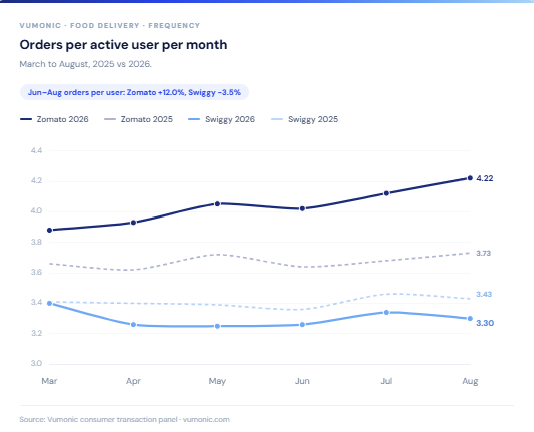
An active Zomato user placed 4.22 orders in August 2026. A year earlier the figure was 3.73. It is the highest monthly reading in two years of data, and it came after five straight months of increases.
Swiggy went the other way. Its active users placed 3.30 orders in August, slightly below the 3.43 of August 2025.
46
Across June to August as a whole, orders per active user rose 12.0% on Zomato and fell 3.5% on Swiggy.
Basket size moved in the opposite direction on each platform. Zomato's average order value slipped 3.1% year on year, to about INR 360. Swiggy's rose 5.6% to about INR 370, the step change in April covered in our earlier post on Swiggy's discounting.
Put frequency and basket together and the monthly spend of an active user grew 8.5% on Zomato and 1.9% on Swiggy. Zomato is winning on how often people come back. Swiggy is winning on how much they spend when they do.
The monsoon itself changed less than expected on either platform. Late-night ordering held steady through June, July and August. The clearest seasonal signal was in cold desserts: ice cream, shakes and juices fell from 2.80% of Zomato orders in May to 2.25% in August, a pattern that repeated almost exactly from 2025.
For a restaurant brand, the two platforms are now rewarding different things. On Zomato, the opportunity is repeat ordering from a customer base that is coming back more often every month. On Swiggy, it's basket size, with fewer orders per user but more spent on each one.
Tags: Food delivery · Swiggy · Zomato · Order frequency · AOV · Monsoon 2026 · Consumer panel data
Get in touch with us for SKU-level insights for your category!