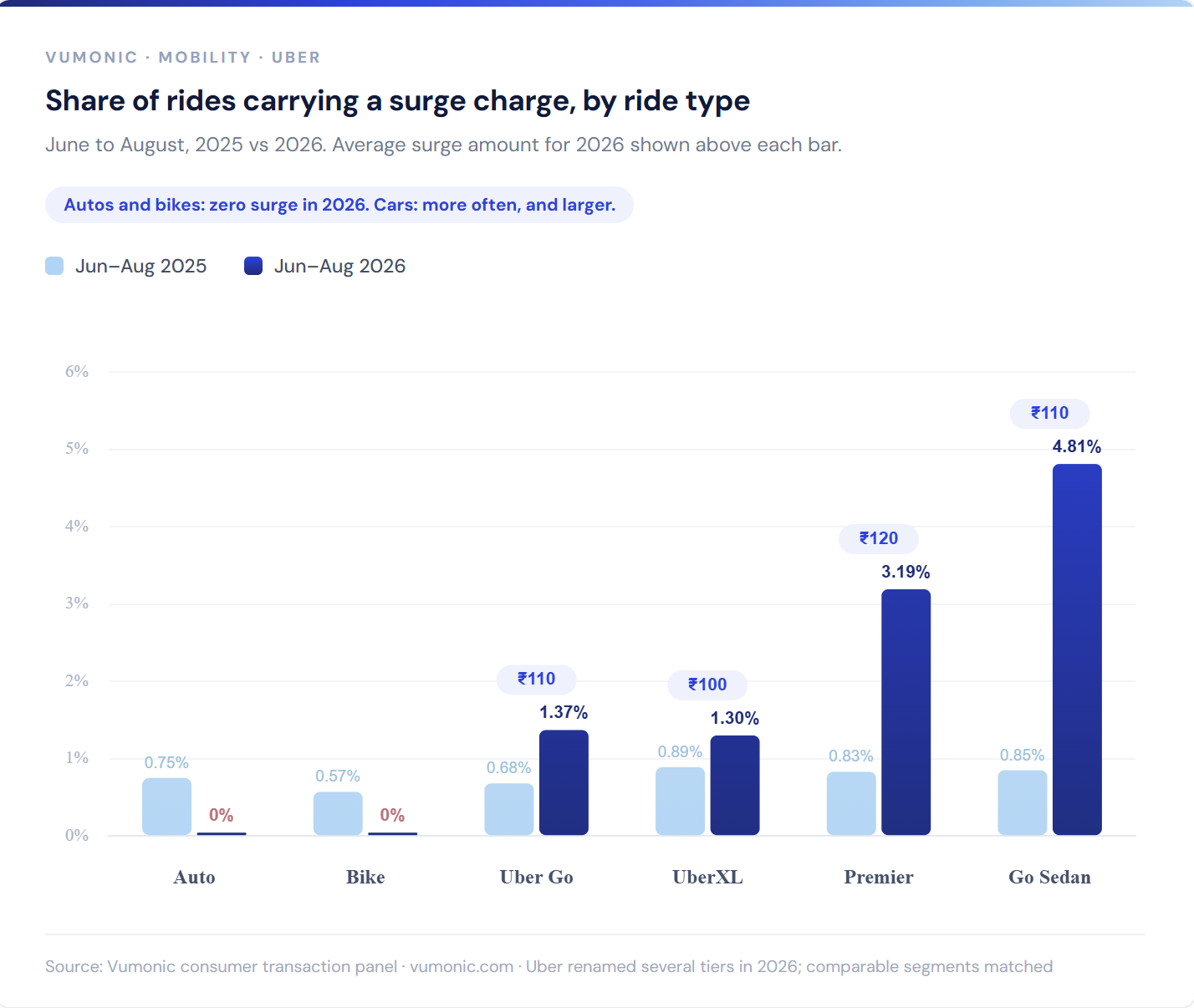
Between June and August 2025, surge charges showed up on autos, bikes and cars alike. Between June and August 2026, not a single auto or bike ride in the panel carried one.
That matters because autos and bikes are most of what Uber does in India. Autos alone were 38.9% of rides this monsoon, and the two bike tiers added another 28.5%. Two-thirds of the platform's rides now run without surge on the receipt at all.
40
Surge didn't go away. It moved up the fleet and got heavier. Go Sedan rides carried surge 4.81% of the time this monsoon, against 0.85% a year earlier, with the average charge rising from about INR 80 to INR 110. Premier went from 0.83% to 3.19%, at about INR 120 against INR 90. Uber Go AC surged on 1.37% of rides at about INR 110.
The larger the car, the more often surge applied and the more it cost.
Across all rides the headline looks muted: surge appeared on just 0.44% of trips in August, the lowest month in two years. But when it did apply, it averaged about INR 120, three times the INR 40 of August 2025. The number moved from being a small, common charge to a large, rare one.
The monsoon itself changed less than expected. Surge frequency actually fell through the season, from 0.61% of rides in June to 0.46% in July and 0.44% in August. What rose, month after month, was the size of each surge: about INR 100 in June, INR 110 in July, INR 120 in August. Rain did not make surge more common. It made each instance more expensive.
For anyone pricing a commute, the practical read is simple. On a two-wheeler or an auto, the fare you see is now the fare you pay. In a sedan or Premier during peak hours, the chance of surge is roughly five times higher than a year ago, and the bill when it lands has grown by around a third.
Tags: Mobility · Uber · Surge pricing · Ride-hailing · Monsoon 2026 · Consumer panel data
Get in touch with us for SKU-level insights for your category at vumonic.com