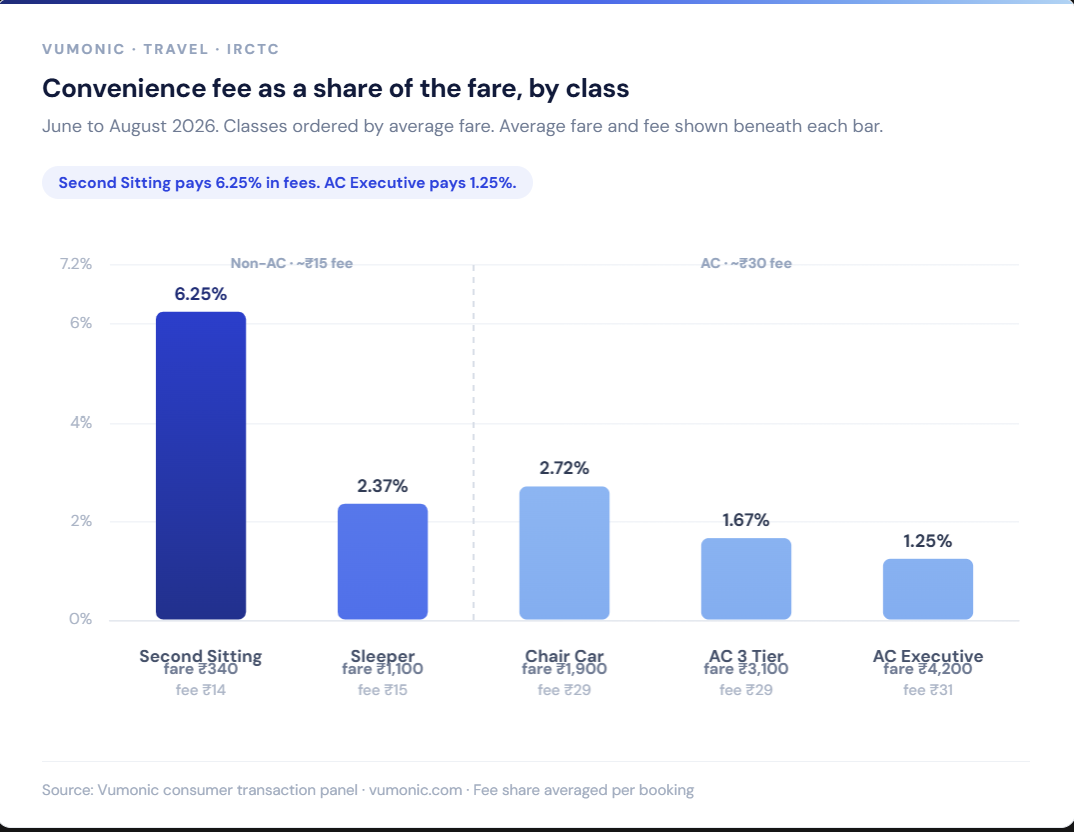
A Second Sitting ticket booked on IRCTC this monsoon cost about INR 340. The convenience fee on it came to about INR 14, or 6.25% of the fare.
An AC Executive ticket cost about INR 4,200. Its convenience fee was about INR 30, or 1.25% of the fare.
Same platform, same booking flow, five times the proportional cost.
44
The reason is structural. The fee barely varies with the fare. Across 99% of IRCTC bookings in the panel it lands in one of two bands: about INR 14 to 15 for non-AC classes and about INR 29 to 31 for AC classes. A cheap ticket and an expensive one in the same band pay the same amount, so the cheaper ticket absorbs a larger share.
Inside each band the effect repeats. Among non-AC classes, the fee is 6.25% of a Second Sitting fare and 2.37% of a Sleeper fare, which costs about INR 1,100. Among AC classes it's 2.72% of a Chair Car fare, 1.67% on AC 3 Tier and 1.25% on AC Executive. Chair Car lands higher than Sleeper because it moves into the AC fee band while still costing well under INR 2,000.
None of this changed from last year. The fee, the fare mix and the percentages all sit within a few tenths of a point of June to August 2025.
Travel insurance runs the other way. It costs about INR 1 per booking, and the passengers buying the cheapest tickets are the most likely to add it: 70.0% of Second Sitting bookings and 70.3% of Chair Car bookings included it, against 58.2% for AC Executive. The travellers paying the highest share of their fare in fees are also the ones most likely to pay a little extra for cover.
For anyone modelling rail travel costs, the headline fare understates the real price most for the passengers who can least absorb it. On a short-haul unreserved-style journey, the fee is closer to a 6% surcharge than a rounding error.
Tags: Travel · IRCTC · Indian Railways · Convenience fee · Consumer panel data
Get in touch with us for SKU-level insights for your category at vumonic.com